
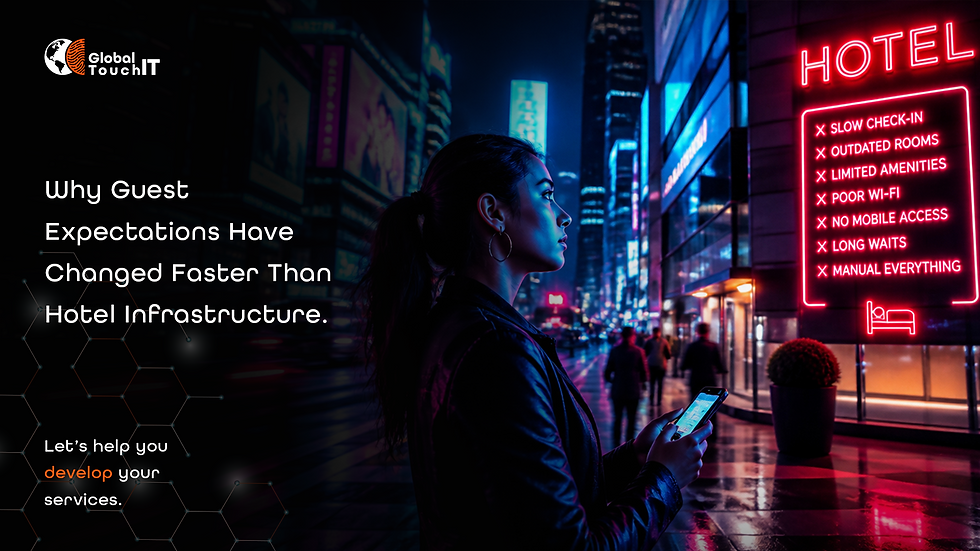
Why Guest Expectations Have Changed Faster Than Hotel Infrastructure

Heritage Month celebrates what has stood the test of time. In hospitality, that often means culture, tradition, and a sense of place that cannot be replicated.
But there is a tension the industry cannot ignore. While heritage is built over decades, guest expectations are changing in a matter of months.
This is where many properties are being caught off guard. Not because they lack quality or identity, but because the pace of change has shifted beyond what traditional infrastructure was ever designed to support.
THE WORLD CHANGED AND SO HAVE EXPECTATIONS
Guest behaviour did not evolve slowly, It accelerated.
Digital convenience is now embedded in everyday life. People book, pay, communicate, and consume instantly. That mindset does not switch off when they travel. It follows them into every hotel, lodge, and guesthouse. The expectation is simple. Things should work, and they should work quickly.
INFRASTRUCTURE WAS BUILT FOR A DIFFERENT ERA
Many hospitality systems were designed for stability, not speed.
They worked well in a time when guest interactions were slower, processes were manual, and demand on networks was limited. Today, that same infrastructure is expected to support constant connectivity, multiple devices per guest, and real-time operations. It is not failing because it is poorly built. It is struggling because the environment around it has changed.
HERITAGE CAN SOMETIMES SLOW DOWN CHANGE
Properties with strong heritage often carry established ways of operating. That consistency is valuable, but it can also create resistance to change.
Processes remain in place because they have always worked. Systems are kept longer than they should be. Technology upgrades are delayed in favour of preserving familiarity. Over time, this creates a disconnect. The experience feels authentic, but the service delivery feels outdated.
THE GAP IS FELT IN SMALL MOMENTS
The problem rarely shows up as one major failure. It appears in small, repeated frustrations.
A slow check-in. Unreliable Wi-Fi. Delayed responses. Systems that do not communicate with each other. Individually, these seem minor. Together, they shape the overall perception of the stay. Guests may not understand the cause, but they recognise the inconsistency.
MODERNISATION DOES NOT MEAN LOSING IDENTITY
There is a misconception that upgrading systems will dilute what makes a property unique.
The opposite is true. When operations run smoothly, staff have more time to focus on guest engagement, storytelling, and personalised service. The essence of the property becomes more visible, not less.
Technology should handle the complexity so people can focus on the experience.
WHY TIMING MATTERS NOW
The gap between expectation and delivery is not static. It is widening.
As guest expectations continue to rise, properties that delay upgrading their infrastructure will find it increasingly difficult to keep up. What feels manageable today can quickly become a competitive disadvantage. Future-proofing is not about reacting late. It is about acting early.
10 QUESTIONS TO ASK DURING HERITAGE MONTH
1. Are we holding onto systems simply because they are familiar?
2. Is our infrastructure built for today’s level of connectivity demand?
3. Where do small inefficiencies show up in the guest journey?
4. Are we aware of how often systems slow down operations?
5. Do our staff spend time working around technology instead of using it?
6. Is our guest experience consistent, or does it depend on circumstances?
7. Are we delaying upgrades that we already know are necessary?
8. Does our technology support our brand, or quietly undermine it?
9. Are we prepared for future increases in demand and expectations?
10. What would a fully modernised version of our operation look like?
These are not easy questions, but they are necessary ones.
Because protecting heritage is not about preserving everything as it is. It is about making sure what matters can continue to thrive. Global Touch IT works with hospitality businesses to bridge this gap. By modernising infrastructure and simplifying operations, we help properties meet today’s expectations without losing what makes them unique.
Heritage should be something guests remember for the right reasons. The experience should feel timeless, but the systems behind it should not.


Comments